


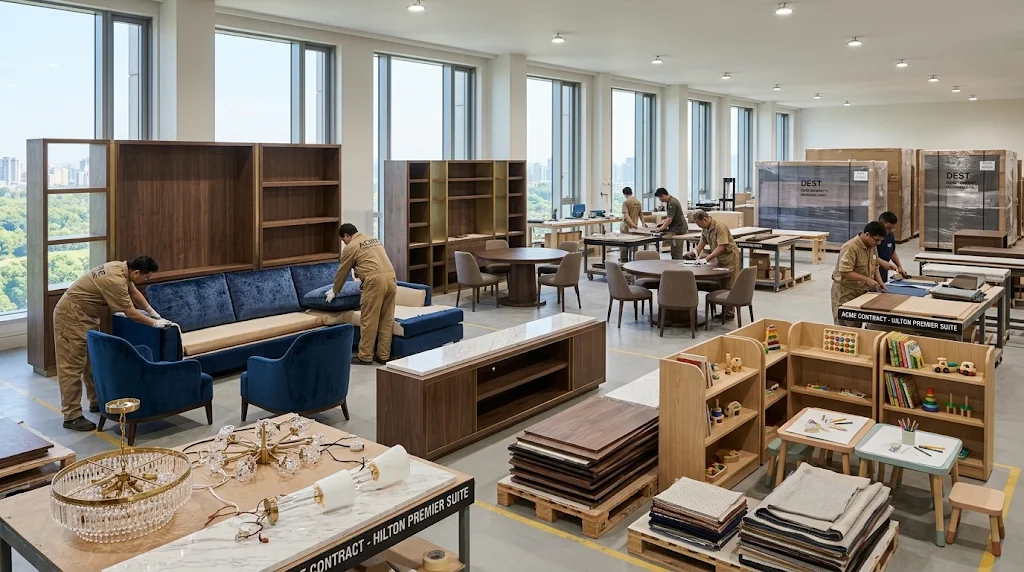
Hotel furniture contract manufacturing is the arrangement where an owner or design team hands a defined furniture package to a factory that builds it to specification, under the buyer's brand and quality requirements. It sounds straightforward: send drawings, get a quote, receive furniture. In practice, the difference between a smooth project and a nine-month dispute usually comes down to how well the factory was vetted before the contract was signed. After more than 25 years building loose and fixed furniture for five-star hotels and resorts, we have seen both sides of that table — as a manufacturer, and alongside owners assessing other factories.
This guide is written from the buyer's side. It covers what hotel furniture contract manufacturing actually involves, the four capabilities you are really buying, how to inspect a factory floor, and the commercial and documentation terms that protect the project when something goes wrong. None of it requires technical expertise in woodworking; it requires knowing what questions to ask and what answers are not good enough.
What contract manufacturing means in hospitality
In hospitality, contract manufacturing usually covers a coordinated package rather than a single product line: guestroom casegoods, soft seating, loose furniture, and often millwork and joinery. The factory is expected to work from an interior designer's drawings, resolve the engineering, produce a prototype, pass the brand's quality review, manufacture the volume, pack for export, and sometimes support installation.
That scope is wider than a typical OEM order, which is why hotel furniture contract manufacturing is a relationship rather than a transaction. The factory must hold a specification across hundreds of units and several room types, keep finishes consistent between production runs, and coordinate a delivery sequence that matches the construction programme. A factory that is excellent at single-product volume can still struggle with the coordination a hotel package requires.
The four things you are really buying
When owners compare factories, they usually compare price per piece. That is the least informative comparison, because the four capabilities that determine success are not visible in a quotation.
- Engineering capability: can the factory read a design intent, propose a buildable construction, and flag problems before production rather than during it?
- Process discipline: is there a documented quality system, or does quality depend on which supervisor is on the floor that day?
- Compliance literacy: does the factory understand which fire, emissions, and timber standards apply in your market, and can it evidence them per order?
- Communication reliability: will you get a straight answer on a schedule slip, or will you discover it when the container does not arrive?
A factory that scores well on all four is worth a higher unit price than one that wins on price and fails on two. The cheapest quote in hotel furniture contract manufacturing is frequently the most expensive project.
Vetting the factory floor
A factory visit is still the most useful due-diligence step, whether in person or by guided video walk-through. What matters is not the showroom but the production floor, the material store, and the quality station. Look for organisation: timber and board stored flat and dry, hardware segregated and labelled, work-in-progress tracked, and a defined area where finished pieces are inspected before packing.
Ask to see a piece in production for another client, with the drawings and the inspection record alongside it. A factory that can show the link between drawing, build, and inspection is running a system. A factory that shows only finished pieces in a showroom is showing you a portfolio, not a process.
Check the machines against the scope. CNC capability, edge banding, veneer pressing, upholstery lines, and finishing booths each tell you what the factory can do in-house and what it will subcontract. Subcontracting is not disqualifying, but it must be declared, because it changes the quality control and the lead time.
Capacity, scheduling, and the promise you can hold them to
Every factory says it can meet the schedule. The useful question is what else is on the floor during your production window. A factory running at full capacity with several hotel projects in parallel may still accept your order and then sequence it behind work that arrived earlier or pays faster.
Ask for a written production slot, not a lead-time estimate. The slot should state when your raw materials are reserved, when production begins, and when the finished goods are ready for packing. Tie it to the contract schedule and to the delivery sequence the site needs. A credible manufacturer will commit a window in writing; a vague one will say "about eight weeks" and mean something different by the time you chase it.
It is also fair to ask how the factory handles a slip. The answer reveals more than the promise: a partner with a documented recovery plan — overtime, re-sequencing, partial shipment — is safer than one that simply assures you it never happens.
Documentation and compliance: the part buyers under-specify
Compliance is where an apparently cheap contract manufacturing arrangement becomes expensive. The fire performance of upholstery and foam, the emissions class of boards, the legality of timber, and the electrical safety of integrated elements all need evidence tied to the actual materials used on your order — not a certificate for a similar product from a previous year.
List the documentation you require as a contract deliverable: certificates for each material batch, a bill of materials that matches the specification, care and cleaning instructions, and the inspection records for the finished goods. When these are named in the purchase order, they become an obligation. When they are left to "the factory will provide", they arrive late, incomplete, or not at all.
For a project in a regulated market, it is worth asking the factory to walk you through a recent compliance pack it produced for a similar destination. The speed and coherence of that answer tells you whether compliance is a system or a scramble.
Communication and project management
Hotel furniture contract manufacturing runs on decisions: drawing approvals, finish selections, prototype comments, change orders. A factory that responds slowly to a design query becomes a bottleneck for the whole programme, even if its production is excellent. Before award, test the response: send a technical question and see how long a substantive answer takes.
Agree a single point of contact on both sides, a weekly written status update covering production, quality, and logistics, and a defined process for change orders. The status update matters more than it sounds: it is the early-warning system that prevents a small delay from becoming an opening-date problem.
Commercial terms to lock before you sign
The commercial structure should make the factory's incentives align with the project's. Payment milestones tied to verified progress — prototype approval, production start, pre-shipment inspection, delivery — are safer than a large deposit followed by a balance on shipment. The inspection right should be explicit, including the right to reject non-conforming goods before they leave the factory.
Warranty terms, spare parts availability, and the ownership of drawings and tooling should all be settled in the contract. If the factory holds custom tooling, state who owns it and what happens if the relationship ends. These clauses cost nothing at signature and save a great deal later.
Red flags worth taking seriously
| Signal | Why it matters |
|---|---|
| No written production slot | Your order has no protected position in the factory's schedule |
| Certificates for "similar" materials | Compliance evidence must match the actual build, or it is not evidence |
| No inspection record | Quality is being checked by eye at packing, not by a documented process |
| Undeclared subcontracting | Quality and lead time are now outside the factory you vetted |
| Slow technical answers | Design decisions will bottleneck during the most time-sensitive phase |
Frequently asked questions
What is the difference between contract manufacturing and OEM?
OEM usually means the factory builds a product to the buyer's brand specification. Contract manufacturing in hospitality is broader: engineering, prototyping, compliance, packing, and often installation support across a whole furniture package.
Should we visit the factory before signing?
Yes, or arrange a guided video walk-through of the production floor, material store, and inspection area. A showroom visit alone does not reveal process discipline.
How many factories should we compare?
Three is usually enough to see the range of capability without exhausting the team. Compare engineering answers and documentation, not just unit price.
What payment structure is normal?
Milestones tied to verified progress: deposit on award, payment after prototype approval, payment at production start, balance after pre-shipment inspection. Avoid a structure that pays most of the value before you have seen the goods.
Who owns the drawings and tooling?
That should be stated in the contract. For custom designs, the buyer normally owns the drawings; tooling ownership and transfer should be explicit if the relationship ends.
Hotel furniture contract manufacturing rewards preparation. Visit the floor, test the communication, demand a written production slot, name the compliance documents in the purchase order, and structure payment against verified progress. Do that, and the factory becomes a partner rather than a risk you discover halfway through production.
Why global hospitality teams work with OC International
OC International (OCI) has manufactured loose and fixed furniture for five-star hotels, resorts, and serviced residences since 1997. From our manufacturing base in Dongguan we support owners, developers, design firms, and FF&E consultants across the Americas, the Middle East, and Asia with one accountable team covering design development, production, quality control, packing, shipping, and on-site installation.
What our manufacturing base delivers
- In-house casegoods, soft seating, millwork and joinery under one roof — one specification, one documented quality system, one point of accountability.
- Builds engineered to the fire-safety and emissions standards your market requires — CAL 117, CAL 133, TB 133, EN 1021, BS 5852, FSC timber, and CARB P2 — under an ISO 9001-controlled production process.
- Prototype-to-volume discipline: a signed mock-up is the reference standard every production order is measured against.
- Written production slots and a weekly status report covering build, quality, and logistics.
Selected delivered projects
Our furniture has been delivered to landmark properties including the Fairmont Austin, Four Seasons Chicago, Sheraton Dhaka, Marriott Sydney, Conrad Los Angeles, and Hilton DoubleTree projects across multiple regions — each specified to the operator's brand standard and installed to opening.
Comparing factories for hotel furniture contract manufacturing? Send us the package and we will answer the technical questions first.
See loose furniture sets Request a factory review callYour email address will not be published. Required fields are marked *